

Observing Static Electricity using Light
Let's take a look!
What type of experiment is this?
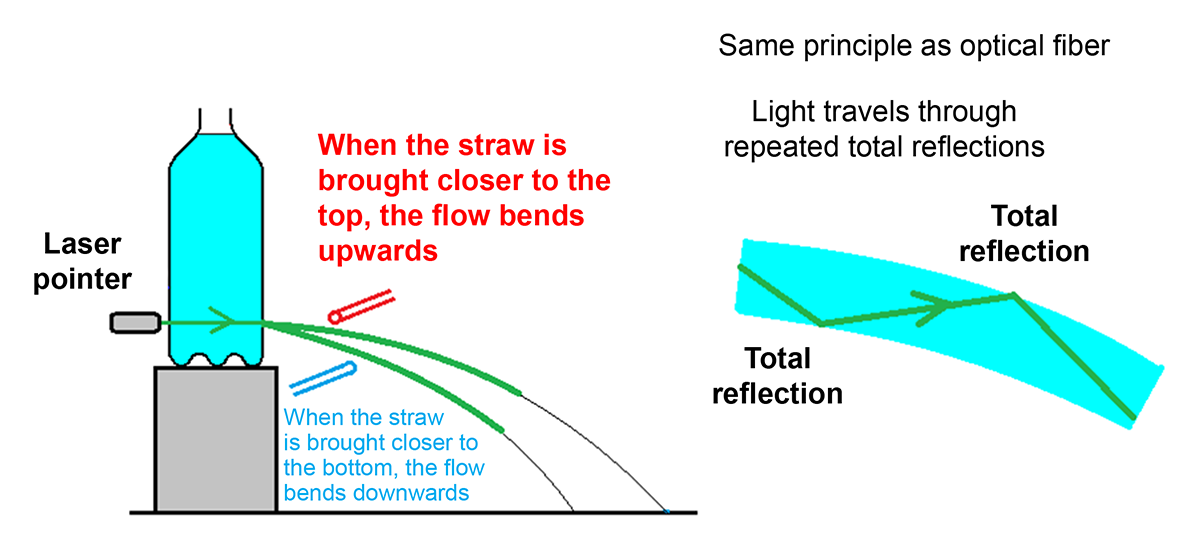
Experimental procedure and explanation:
- Previously, I introduced the experiment “Propelling water far away with static electricity.” When a straw rubbed with tissue paper is brought near a water stream, the water is attracted to it.
- Let’s combine this with the “Water as Optical Fiber” experiment to observe how the water flow changes.
- Shine a laser pointer (or flashlight) behind the water flowing from the side of a bottle. In a darkened room, the flowing water will appear to glow. To better see the light path, lightly color the water with paint or a similar substance—colorless, transparent water makes the light difficult to observe.
- Rub a straw with tissue paper, then bring it close to the flowing water. The water stream will be attracted and bend toward the straw.
- When rubbed, the straw acquires a negative charge. Water molecules are polar: the hydrogen side carries a partial positive charge, and the oxygen side carries a partial negative charge. The positively charged hydrogen atoms are attracted to the negatively charged straw, causing the water flow to bend toward it. For more details, refer to the experiment “Propelling water far away with static electricity.”
- This video was produced with the support of the JSPS Grant-in-Aid for Scientific Research (18K03956).
| [Keywords] | Total internal reflection |
| [Related items] | Water as Optical Fiber, Propelling water far away with static electricity |
Last Update:2021.10.1