

Container and Lid 2 (Container with a Hole)
Let's take a look!
What type of experiment is this?
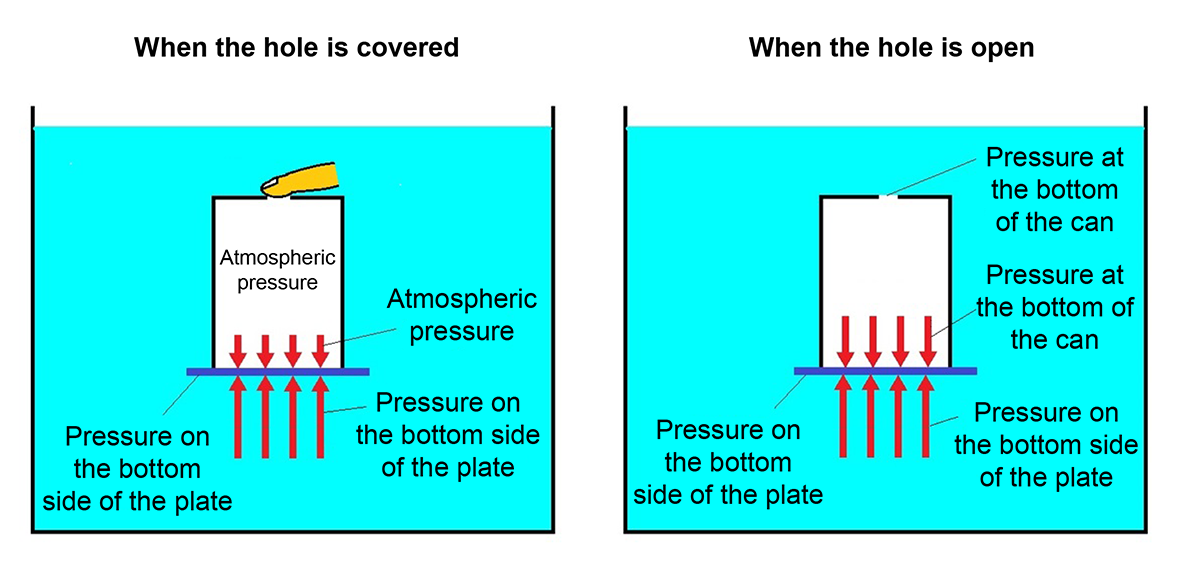
Experimental procedure and explanation:
- An empty can with a hole at the bottom is covered with a plate and submerged underwater, with the plate facing downward. Cover the hole with your finger before submerging the can.
- When the finger covering the hole is released, the plate remains in place and nothing happens.
- Initially, with the hole sealed, the air pressure inside the can is close to atmospheric pressure.
- At this point, the top surface of the plate is pushed downward by atmospheric pressure, while the bottom surface is pushed upward by the greater water pressure at depth. Because the upward force is stronger, the plate stays in place.
- When you release your finger, the air pressure inside the can increases and equalizes with the water pressure at the bottom.
- As expected, the pressure pushing up on the underside of the plate is greater than the pressure at the shallow hole, so the plate remains in place and does not come off.
- The hole at the bottom of the can is small, and surface tension at the water–air interface prevents water from entering through the hole.
- This video was produced with the support of the JSPS Grant-in-Aid for Scientific Research (18K03956).
| [Keywords] | Depth and pressure |
| [Related items] | |
| [References] | The Japan Society of Mechanical Engineers, “The Wonder of Flow,” Kodansha Bluebacks, pp. 38–41. Ryozo Ishiwata, “Illustrated Fluid Dynamics Trivia,” Natsume Publishing, pp. 18–19. |
Last Update:2021.12.1