

Container and Lid 4 (Lid is Lighter than Water)
Let's take a look!
What type of experiment is this?
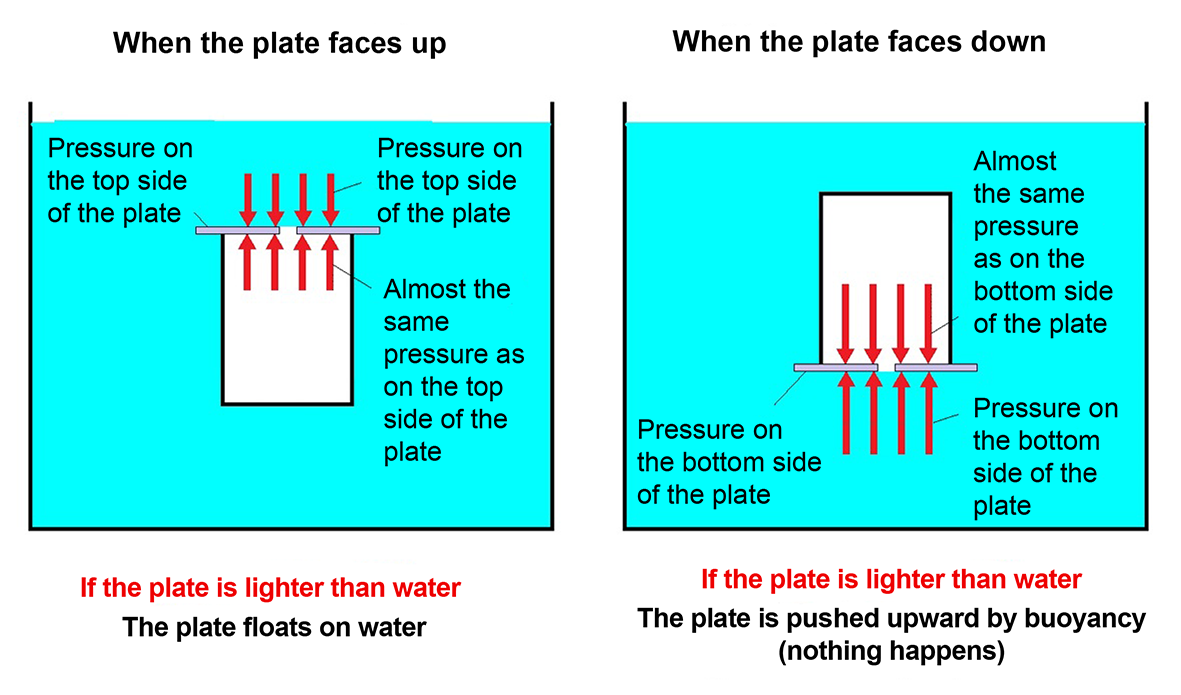
Experimental procedure and explanation:
- Cover the hole at the bottom of the can with vinyl tape, and drill a small hole in the plate.
In this video, a Styrofoam plate, which is lighter than water, was used. - First, cover the hole in the can with your finger and submerge it with the plate facing upward.
- When the finger is released, the plate floats up.
- The air pressure inside the can and the water pressure outside the hole are nearly equal. As a result, the forces acting on the top and bottom of the plate are balanced.
- In this case, the plate floated because it was lighter than water.
- Note that the hole in the plate is small, and surface tension at the water–air interface prevents water from entering through the hole.
- Next, cover the hole with your finger and submerge the can with the plate facing downward.
- When the finger covering the hole is released, the plate remains in place and nothing happens.
- The air pressure inside the can and the water pressure outside the hole are nearly equal. As a result, the forces acting on the top and bottom of the plate are balanced.
- In this case, the plate remained pressed against the container because it was lighter than water.
- This video was produced with the support of the JSPS Grant-in-Aid for Scientific Research (18K03956).
| [Keywords] | Depth and pressure |
| [Related items] | |
| [References] | The Japan Society of Mechanical Engineers, “The Wonder of Flow,” Kodansha Bluebacks, pp. 38–41. Ryozo Ishiwata, “Illustrated Fluid Dynamics Trivia,” Natsume Publishing, pp. 18–19. |
Last Update:2021.12.1