

Balloon Car 1 (Mechanism)
Let's take a look!
What type of experiment is this?
Experimental procedure and explanation:
- Let’s make a simple toy called a balloon car.
- Attach a balloon to a small dolly or cart (in this video, a 22 cm balloon is used).
- If available, insert a pipe or a similar object into the balloon’s opening to keep it from collapsing—though this is optional.
- Inflate the balloon and then release it. The car will start moving on its own.
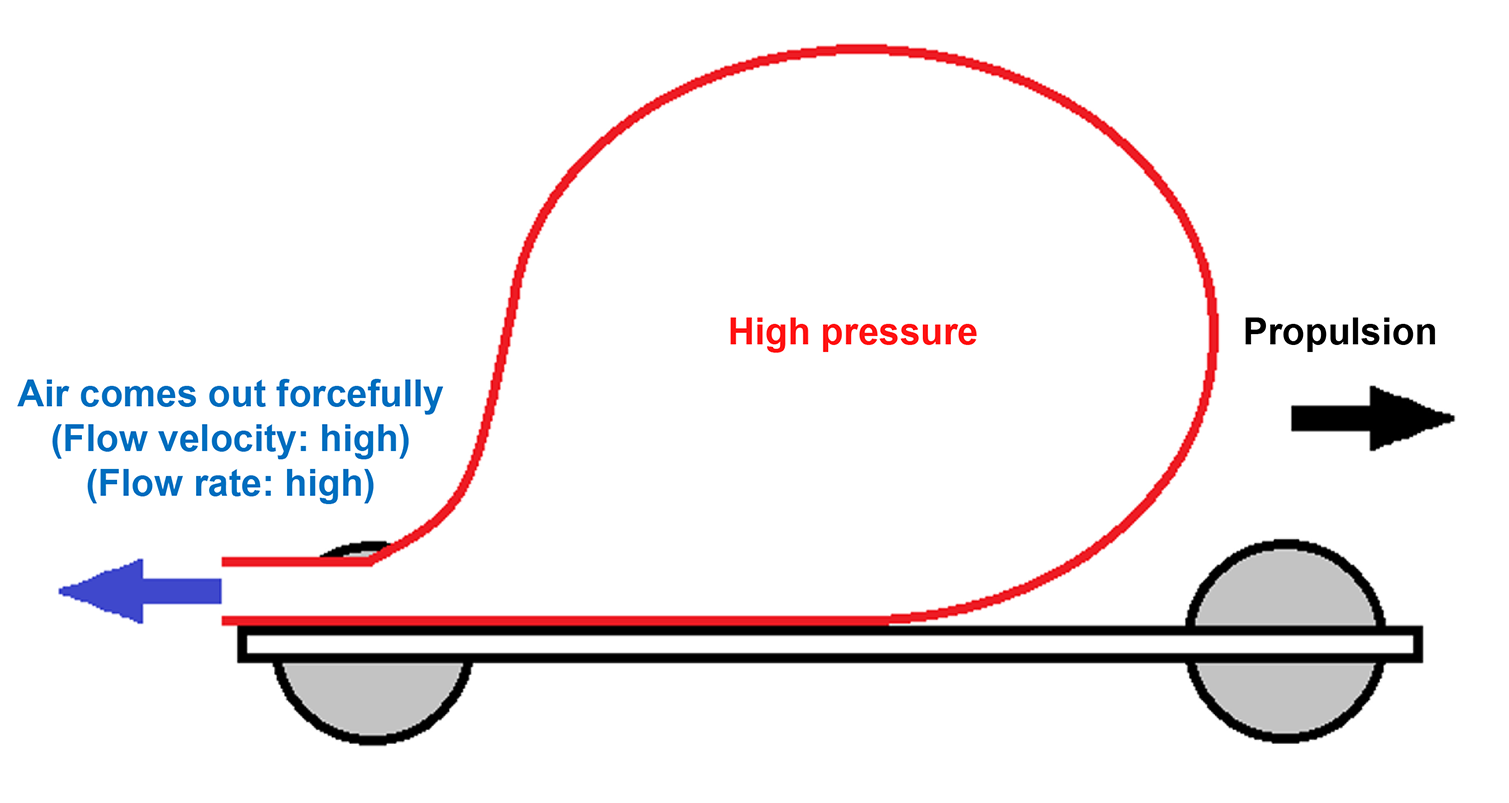
- This movement demonstrates the principle of “Jet Propulsion”: when air is expelled forcefully backward from the balloon, the reaction force pushes the car forward. This is an example of Newton’s third law of motion (action and reaction).
- The propulsive force depends on both the velocity of the airflow and the flow rate (the volume of air flowing per unit time): (Propulsive force) = (air density) × (flow velocity) × (flow rate).
- Therefore, the greater the amount of air expelled in a short time, the stronger the propulsive force—although this also means the force acts for a shorter duration, so the car accelerates quickly but only briefly.
- It can be fun to hold races to see which balloon car moves the fastest or travels the farthest!
- A related experiment is the “Wind-powered vehicle,” which uses the same jet propulsion principle. Instead of a balloon, it employs a propeller that blows air backward to propel the vehicle forward.
- This video was produced with the support of the JSPS Grant-in-Aid for Scientific Research (18K03956).
| [Keywords] | Jet propulsion, law of momentum, action–reaction |
| [Related items] | Jet Propulsion, Wind-powered vehicle, Balloon Car 2 |
| [References] | Ryozo Ishiwata and Mitsumasa Nemoto, “The Wonder of Flow,” Kodansha Bluebacks, pp. 114–117. Ryozo Ishiwata, “Illustrated Fluid Dynamics Trivia,” Natsume Publishing, pp. 156–157. |
Last Update:2021.4.1