

Water-powered Car 2 (Low Water Level)
Let's take a look!
What type of experiment is this?
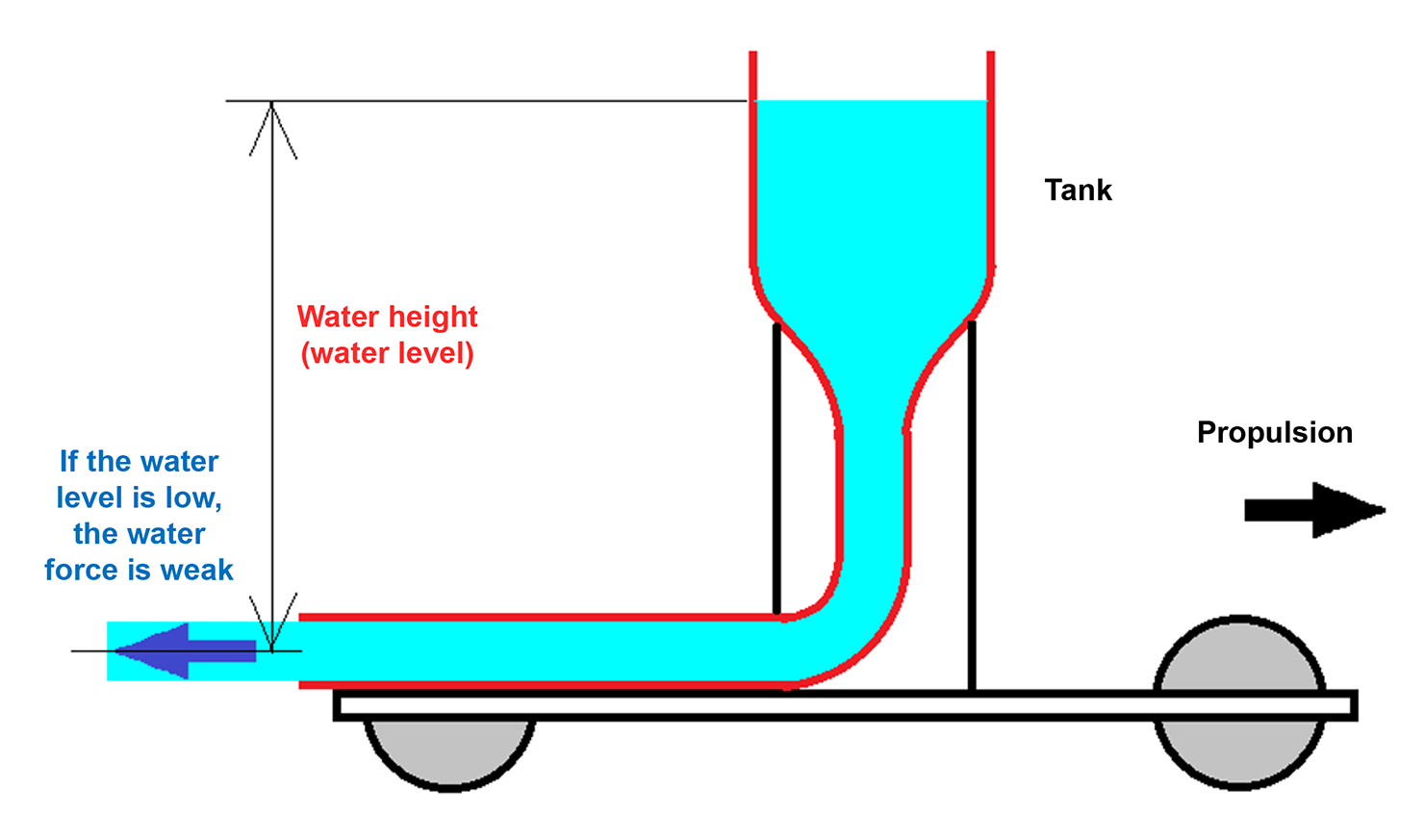
Experimental procedure and explanation:
- Let’s observe how the performance of the “Water-powered Car 1” changes when the water level is lowered.
- To reduce the height of the tank, shorten the supporting plastic bottle so that the water level is approximately 25 cm.
- Fill the tank with water while holding the hose outlet closed with your finger. When you release your finger, water flows out, and the car begins to move. Compared to Water-powered Car 1 (where the water level is about 40 cm), the car moves more slowly and travels a shorter distance when the water level is lower.
- The magnitude of the propulsive force depends on both the flow velocity (the speed at which water flows out of the hose) and the flow rate (the volume of water flowing out per unit time). The propulsive force can be expressed as
(Propulsive force) = (water density) × (flow velocity) × (flow rate). - As demonstrated in the experiment “The Height of Water and Its Energy,” lowering the water level reduces the flow rate at the outlet. Therefore, when the water level in the tank is lower, both the flow velocity and flow rate decrease, leading to a reduction in propulsive force.
- This means the water’s potential energy (height energy) is reduced, resulting in weaker propulsion and diminished car performance.
- This video was produced with the support of the JSPS Grant-in-Aid for Scientific Research (18K03956).
| [Keywords] | Jet propulsion, potential energy, law of momentum, action–reaction |
| [Related items] | Jet Propulsion, The Height of Water and its Energy, Water-powered Car 1 |
| [References] | Ryozo Ishiwata and Mitsumasa Nemoto, “The Wonder of Flow,” Kodansha Bluebacks, |
Last Update:2021.4.1