

Lifting a Balloon with Circulator
Let's take a look!
What type of experiment is this?
Experimental procedure and explanation:
- In previous experiments, “A Balloon that Floats at an Angle” and “Lifting a Huge Balloon with Air,” I used hair dryers and blowers to float balloons. This time, I will conduct a similar experiment using a circulator—a type of fan used to move air and ventilate rooms.
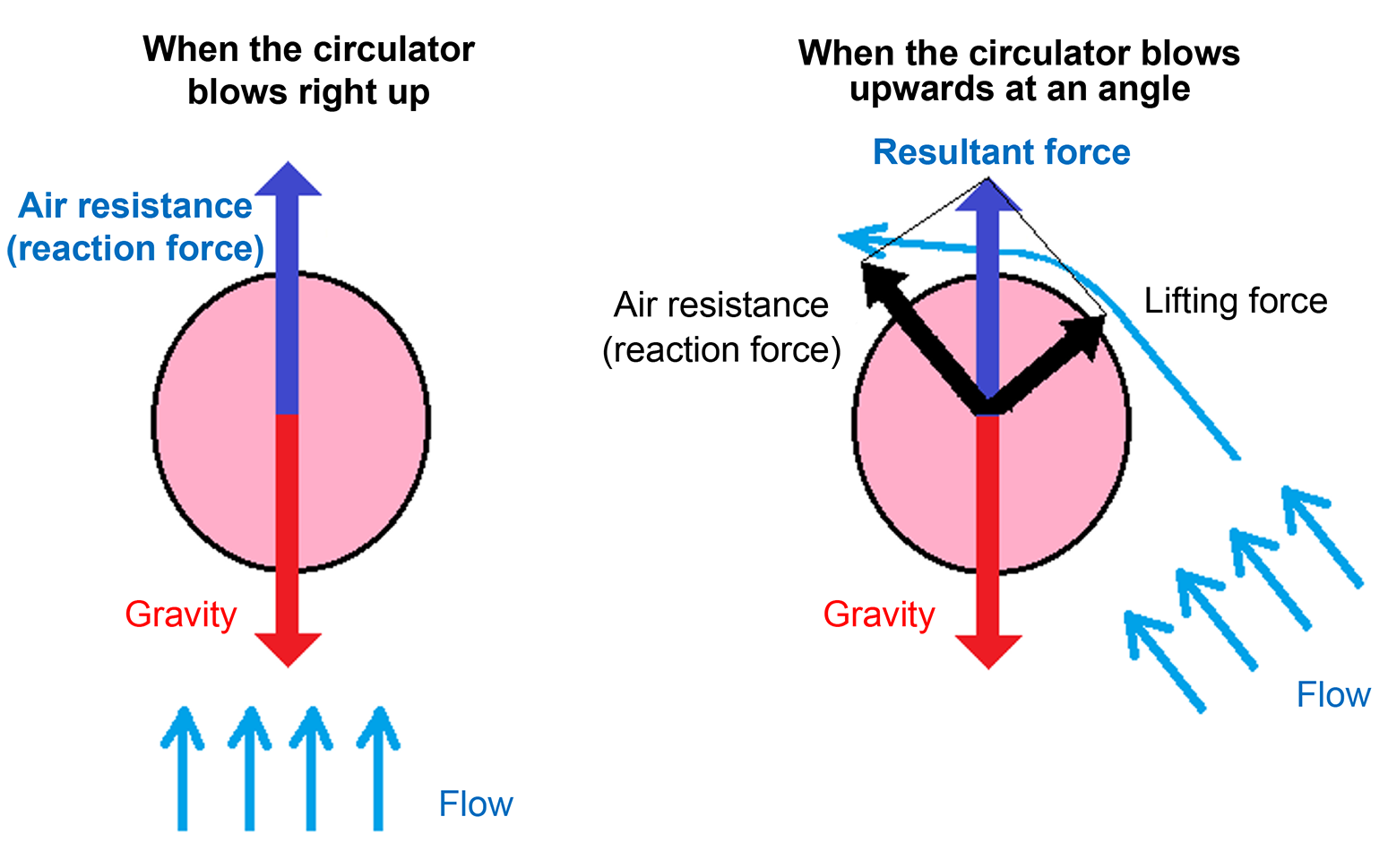
- First, direct the circulator upward and float a small balloon (22 cm in size). As shown in the figure, the downward force of gravity and the upward force of air resistance on the balloon become balanced, allowing the balloon to float in mid-air.
- As the wind speed is increased from low to medium to high, the balloon gradually rises. A stronger wind produces greater air resistance, which increases the upward force and raises the equilibrium point.
- Next, let’s try an experiment where the air is blown at an angle. The balloon does not fall but instead floats at an angle. The principle is the same as in the experiment “A Balloon that Floats at an Angle.” The airflow curves along the surface of the balloon due to the Coandă effect, generating lift (diagonally upward and to the right, as shown in the diagram). Additionally, air resistance acts diagonally upward and to the left. The balloon stabilizes at a point where the lift, air resistance, and gravity are in balance.
- Now, I will try the same experiment using a large balloon (45 cm in size). The results are similar to those observed with the small balloon.
- This video was produced with the support of the JSPS Grant-in-Aid for Scientific Research (18K03956).
| [Keywords] | Properties of flow around objects, Coandă effect |
| [Related items] | A Balloon that Floats at an Angle, Lifting a Huge Balloon with Air |
| [References] | Ryozo Ishiwata and Mitsumasa Nemoto, “The Wonder of Flow,” Kodansha Bluebacks, pp. 128–133. |
Last Update:2022.4.1