

A Balloon that Inflates when Lifted
Let's take a look!
What type of experiment is this?
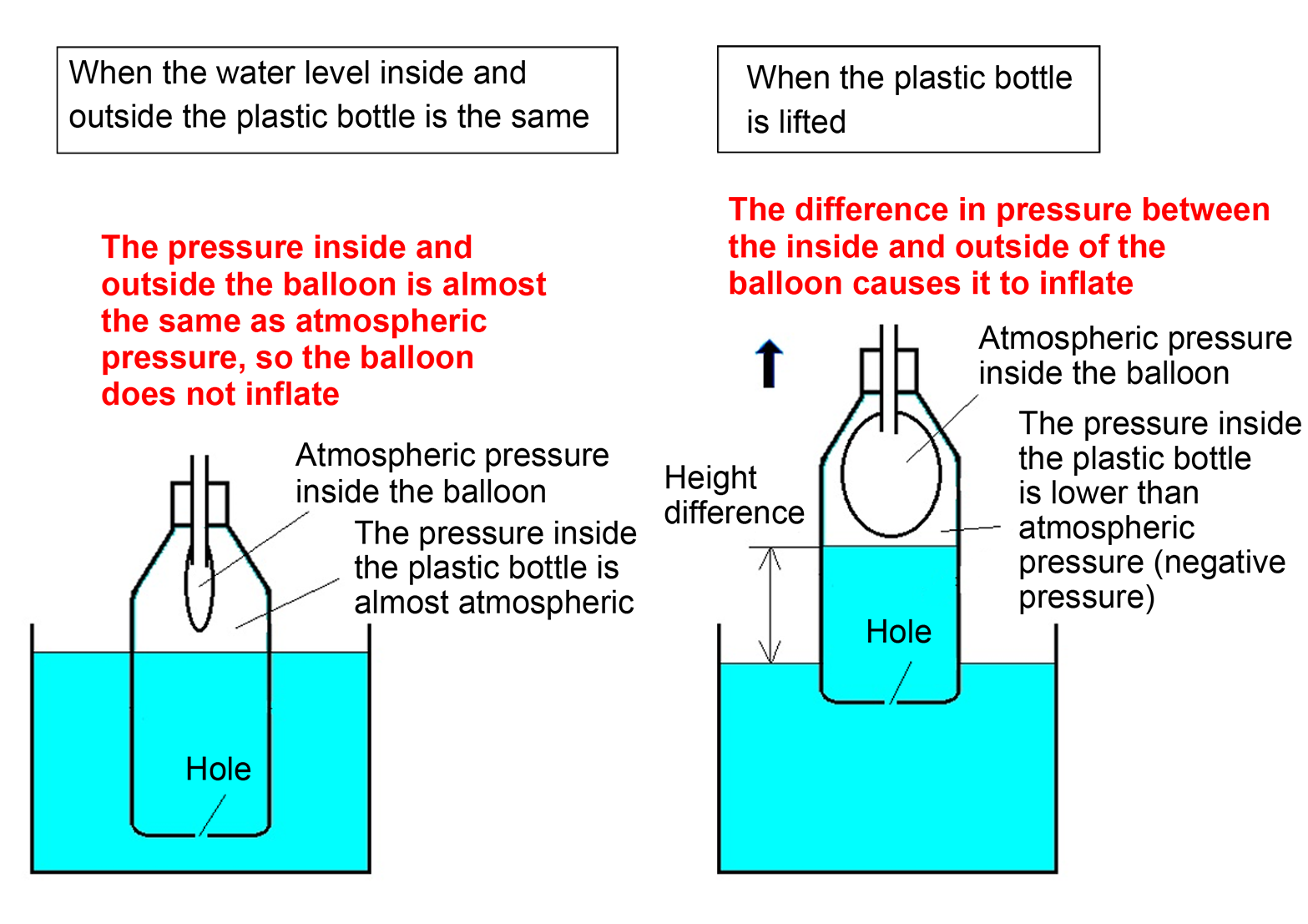
Experimental procedure and explanation:
- There is a balloon inside a plastic bottle.
- When you lift the plastic bottle, the balloon inside inflates. Why does this happen?
- The key is that there is a hole in the bottom of the plastic bottle, connecting the water inside with the water outside.
- Lifting the bottle creates a difference in water levels inside and outside the bottle. Where the water level is low, the pressure is high; where the water level is high, the pressure is low. As a result, the air pressure around the balloon becomes lower than atmospheric pressure (the pressure at the water surface outside), causing the balloon to inflate. This lower-than-atmospheric pressure is called negative pressure.
- The balloon inflates due to negative pressure around it, following the same principle as the “Balloon in a plastic bottle” experiment.
- The air pressure inside the plastic bottle can be calculated by the formula
(Pressure difference) = (Density of water) × (Gravitational acceleration) × (Difference in water level). - For example, if the difference in water level is 20 cm (0.20 m), using the density of water as 1000 kg/m3 (which is 1 g/cm3 when expressed in g and cm, but I will use 1,000 kg/m3 to be consistent with other values) and gravitational acceleration (approximately 9.8 m/s2), the pressure difference can be calculated as
Pressure difference = 1000 × 9.8 × 0.20 = 1960 pascal (Pa) below atmospheric pressure.
This pressure is about 1/50th of atmospheric pressure, a small but sufficient difference to inflate the balloon. - Tip: Inflating the balloon a little before attaching it will weaken the rubber, making it easier to inflate during the experiment.
- This video was produced with the support of the JSPS Grant-in-Aid for Scientific Research (18K03956).
| [Keywords] | Depth and pressure, negative pressure |
| [Related items] | When the plastic bottle is upside down, Balloon in a plastic bottle |
| [References] | Ryozo Ishiwata and Mitsumasa Nemoto, “The Wonder of Flow,” Kodansha Blue Backs, pp. 38–41. Ryozo Ishiwata, “Illustrated Fluid Dynamics Trivia,” Natsume Publishing, pp. 18–19. |
Last Update:2022.6.1