

Is It due to a Pressure Difference?
Let's take a look!
What type of experiment is this?
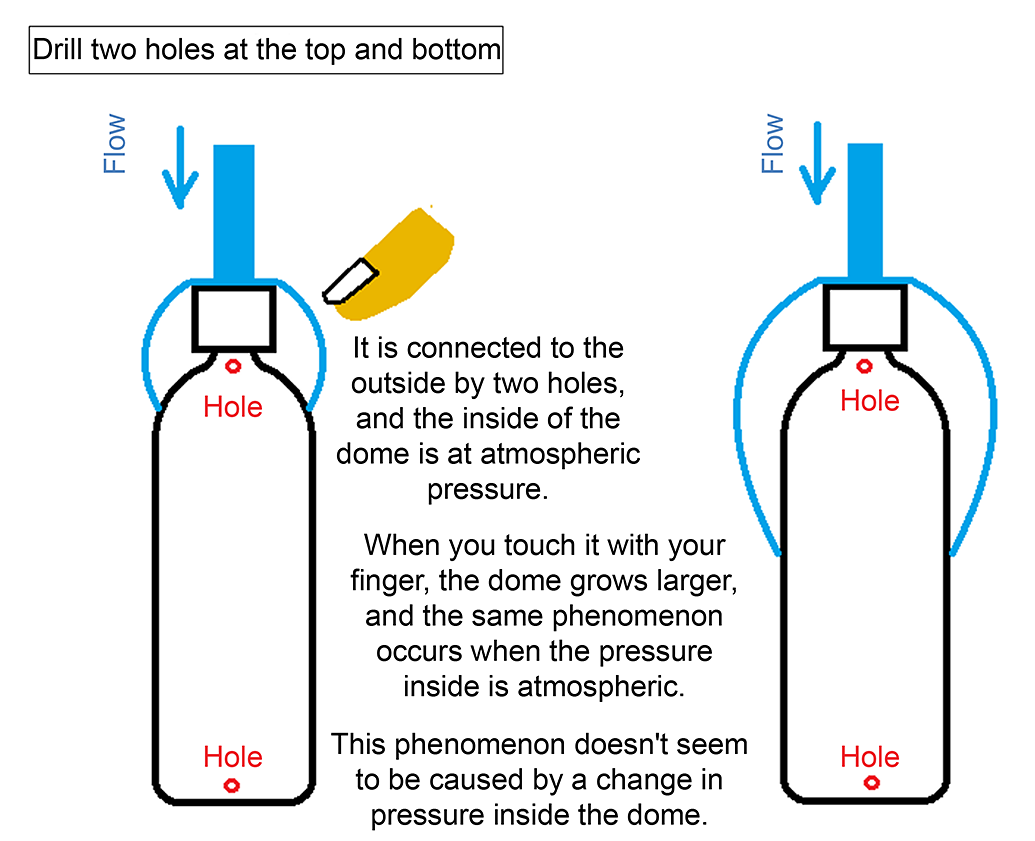
Experimental procedure and explanation:
- Various explanations have been proposed for the phenomenon in which a water dome grows larger when touched with a finger. One such explanation suggests that “initially, the pressure inside the dome differs from atmospheric pressure, and when the dome is touched, the internal pressure equalizes with the atmosphere, causing the dome to expand.” However, is this explanation correct?
- To test this hypothesis, I drilled two small holes—one at the top and one at the bottom of the plastic bottle—to ensure that the inside of the water dome remained at atmospheric pressure by connecting it to the surrounding air. Under these conditions, there should be no pressure difference between the inside and outside of the dome. Let’s experiment under this condition.
- When the dome is touched with a finger in this setup, it still grows larger—just as it does in the original experiment without holes. This observation indicates that a change in internal pressure is not the cause of the dome’s expansion. Therefore, we can conclude that the pressure-change hypothesis is not a valid explanation for this phenomenon.
- Furthermore, even in the absence of holes, it is likely that the pressure inside the dome is already close to atmospheric pressure from the outset. (If there is any pressure difference between the inside and outside of the dome, it would be due to surface tension. However, it is unlikely that such a significant pressure difference could be generated solely by this factor.)
| [Attention] | Water is used throughout these experiments, but it’s important to remember that water is a valuable resource. To minimize waste, consider reusing the water after each experiment—for bathing, cleaning, watering plants, and other practical purposes. |
| [Keywords] | Surface tension, inertia |
| [Related items] | |
| [References] | Ryozo Ishiwata and Mitsumasa Nemoto, “The Wonder of Flow,” Kodansha Bluebacks, pp. 62–67. Ryozo Ishiwata, “Illustrated Fluid Dynamics Trivia,” Natsume Publishing, pp. 48–49. |
Last Update:2022.8.1