

What Causes the Water Dome to Grow?
Let's take a look!
What type of experiment is this?
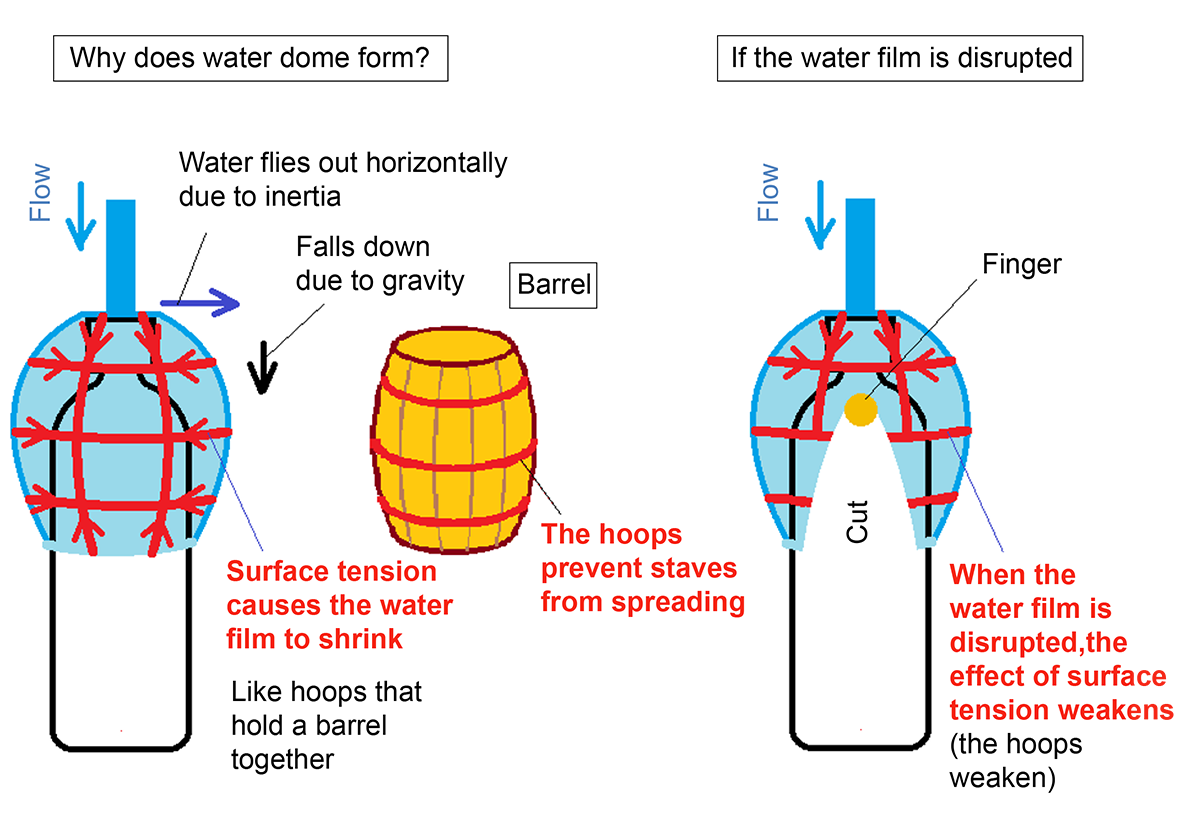
Experimental procedure and explanation:
- The pressure inside the dome and the Coandă effect are not the primary reasons why the water dome increases in size.
- Let us now consider the role of surface tension. First, we examine how surface tension contributes to the formation of a water dome.
- When water first strikes the cap, inertia causes it to spread outward horizontally. Simultaneously, gravity pulls it downward. Additionally, in liquids such as water, cohesive forces between surface molecules work to minimize the surface area. This phenomenon is known as surface tension. Surface tension acts on the water film forming the dome, striving to reduce its surface area. This effect is comparable to the function of a hoop around a barrel— it resists outward expansion. As a result, the water film initially expands outward due to inertia but is then bent downward by gravity, while surface tension counters further spreading. This interplay of forces shapes the water into a dome.
- When the water film is touched with a finger, the film is disrupted. As a result, the influence of surface tension is weakened, allowing the dome to expand outward—similar to how a loosened hoop causes a barrel to swell.
- In summary, touching the water film reduces the cohesive force exerted by surface tension (i.e., loosens the “hoop”), which enables the dome to grow larger.
- This video was produced with the support of the JSPS Grant-in-Aid for Scientific Research (18K03956).
| [Attention] | Water is used throughout these experiments, but it’s important to remember that water is a valuable resource. To minimize waste, consider reusing the water after each experiment—for bathing, cleaning, watering plants, and other practical purposes. |
| [Keywords] | Surface tension, inertia |
| [Related items] | |
| [References] | Ryozo Ishiwata and Mitsumasa Nemoto, “The Wonder of Flow,” Kodansha Bluebacks, pp. 62–67. Ryozo Ishiwata, “Illustrated Fluid Dynamics Trivia,” Natsume Publishing, pp. 48–49. |
Last Update:2022.8.1