

When Two Styrofoam Balls Float
Let's take a look!
What type of experiment is this?
Experimental procedure and explanation:
- Two Styrofoam balls are floated in the airflow from a circulator. The Styrofoam balls should be hollow (sold as two halves) and lightweight so that they can float.
- The two balls move about and occasionally collide, but they do not fall out of the airflow.
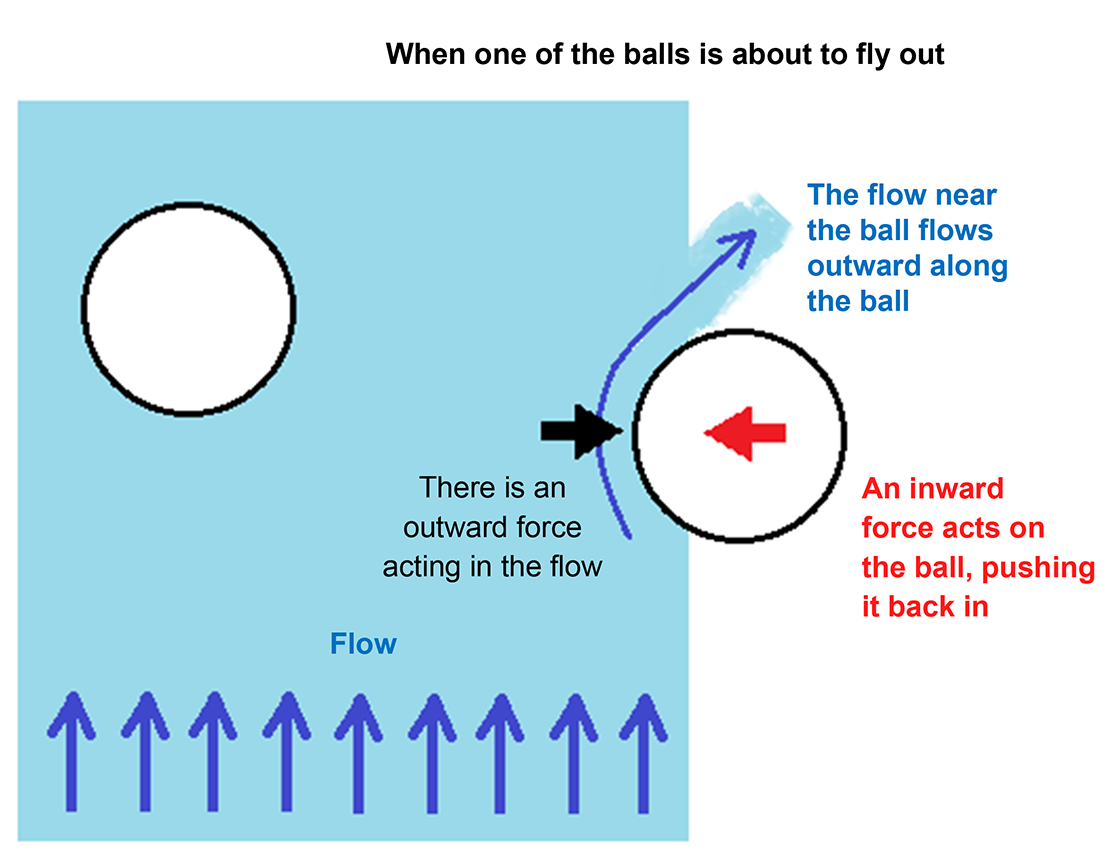
- When a ball starts to drift toward the edge of the flow, the surrounding air curves around the ball due to the Coandă effect and is deflected outward. At this moment, a force arises between the ball and the airflow, pulling them toward each other. The flow experiences an outward force, and by the law of action and reaction, an inward force acts on the ball, pulling it back into the stream. In this way, the balls remain suspended in the flow.
- This video was produced with the support of the JSPS Grant-in-Aid for Scientific Research (18K03956).
| [Keywords] | Properties of flow around objects, Coandă effect |
| [Related items] | Lifting Three Tied Balloons, Ball that doesn’t quite seem to come out |
| [References] | Ryozo Ishiwata and Mitsumasa Nemoto, “The Wonder of Flow,” Kodansha Bluebacks, pp. 128–133. |
Last Update:2022.4.1