

Miniature Dome
Let's take a look!
What type of experiment is this?
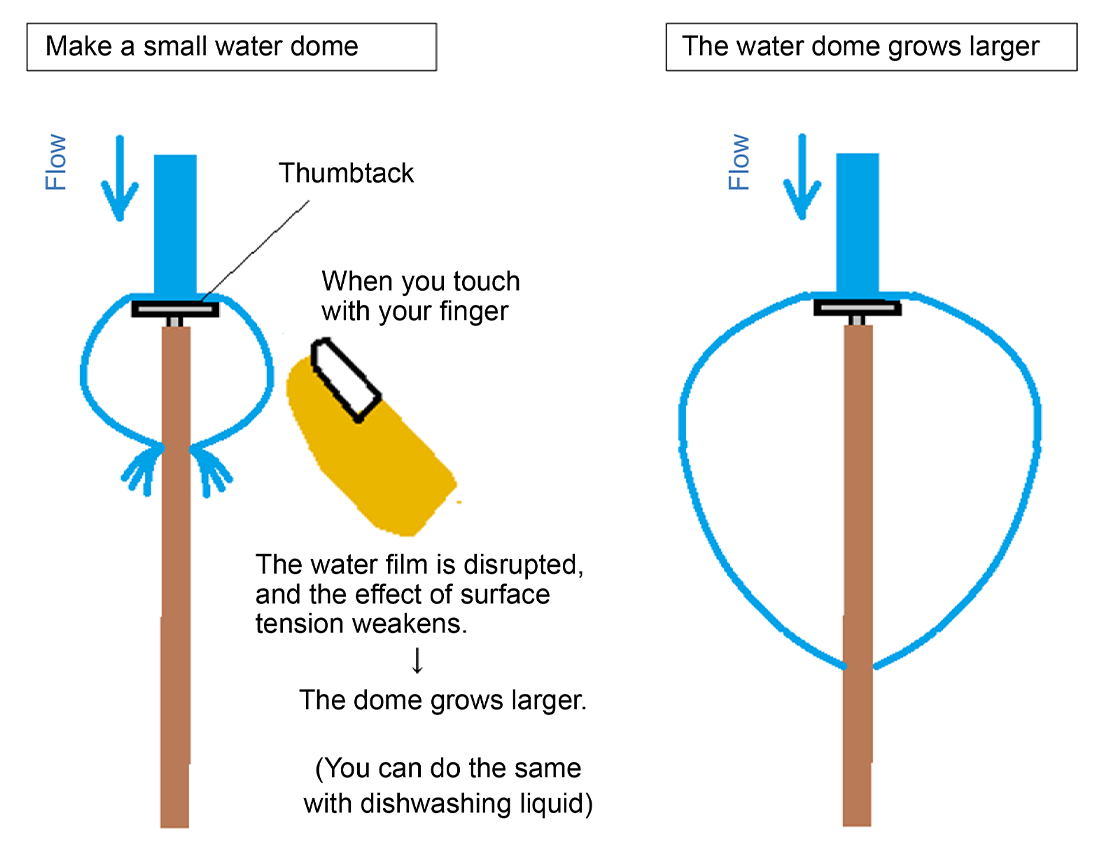
Experimental procedure and explanation:
- Let’s make a simple miniature dome.
- Insert a thumbtack into the end of a chopstick. When you pour water onto the thumbtack, a dome will form.
- Start by making a smaller dome. When you touch it with your finger, the dome grows larger. The same phenomenon occurs as with plastic bottles: the water film is disrupted, weakening the effect of surface tension.
- After the dome grows, surface tension increases again as the water film restores, causing the dome to gradually shrink. When the smaller dome is touched again, it grows larger, and this cycle repeats. This effect is more noticeable in smaller domes because surface tension acts more strongly on smaller objects. The phenomenon is less clear when experimenting with plastic bottles.
- The same effect occurs when spraying diluted dishwashing detergent. Spraying it onto the dome causes the dome to grow larger, as the surface tension is reduced.
- Because the effect of surface tension is stronger on smaller objects, experiments using thumbtacks work better than those using plastic bottles—and they also help save water.
- This video was produced with the support of the JSPS Grant-in-Aid for Scientific Research (18K03956).
| [Attention] | Water is used throughout these experiments, but it’s important to remember that water is a valuable resource. To minimize waste, consider reusing the water after each experiment—for bathing, cleaning, watering plants, and other practical purposes. |
| [Keywords] | Surface tension, inertia |
| [Related items] | What Causes the Water Dome to Grow?, Dishwashing Detergent Makes the Dome Larger |
| [References] | Ryozo Ishiwata and Mitsumasa Nemoto, “The Wonder of Flow,” Kodansha Bluebacks, pp. 62–67. Ryozo Ishiwata, “Illustrated Fluid Dynamics Trivia,” Natsume Publishing, pp. 48–49. |
Last Update:2022.8.1