

Measuring Volume 2 (Things that Float on Water)
Let's take a look!
What type of experiment is this?
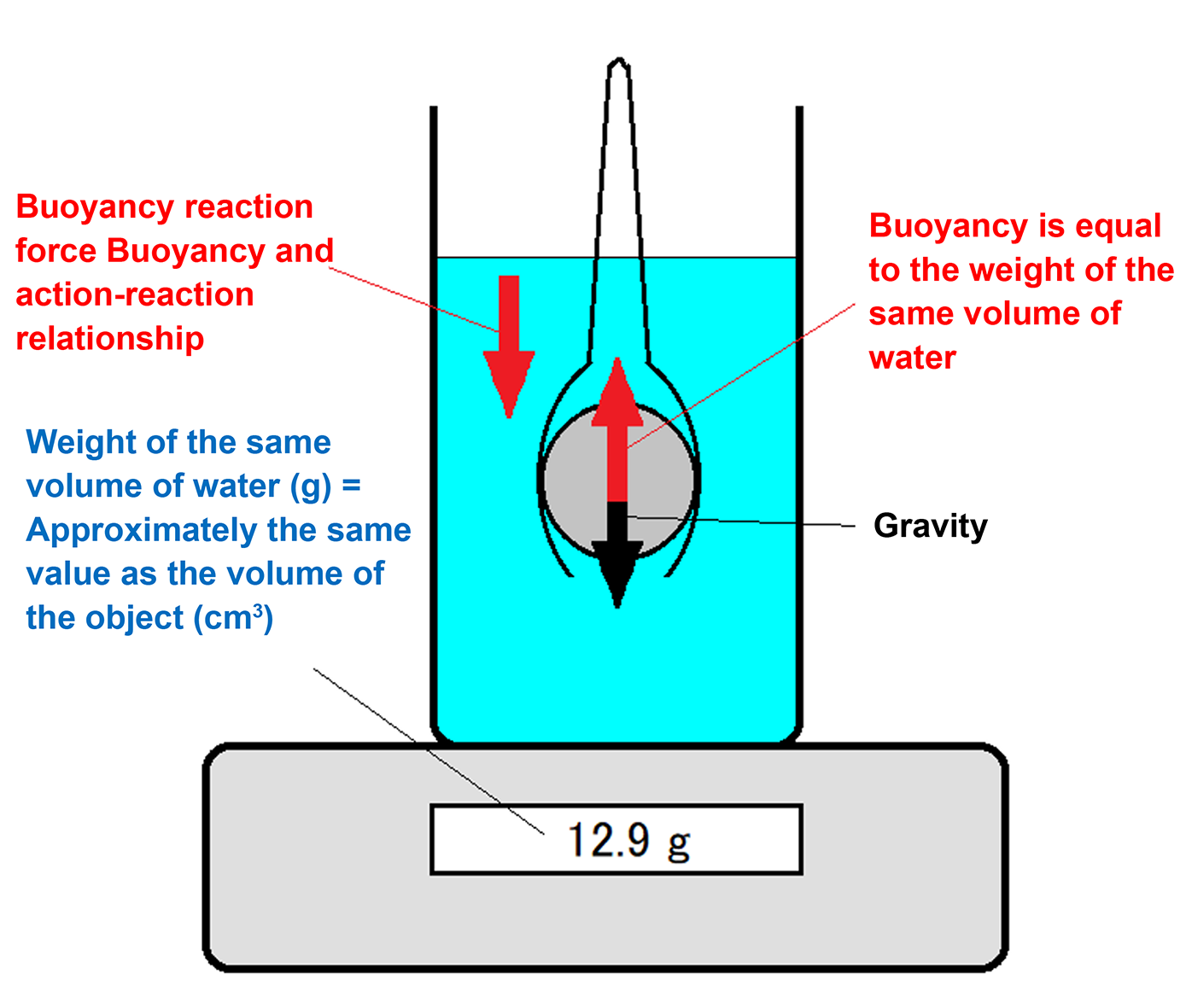
Experimental procedure and explanation:
- Let’s use the property of buoyancy to measure the volume of objects that float on water.
- Place a container filled with water on the scale and reset the display to zero.
- First, measure the volume of the tongs using the same method as in Measuring Volume 1 (Archimedes’ Principle).
- Use Archimedes’ principle to measure the volume as (displayed weight [g]) = (volume of water [cm3]) = (volume of object [cm3]).
- Place the object to be measured in water and check the displayed weight. When immersing the object in water, ensure that it does not touch the bottom of the container, it is fully submerged (not floating above the water surface), and there are no air bubbles clinging to the object.
- In the video, the displayed weight for a ping-pong ball (approximately 40 mm in diameter) was 36.5 g. Therefore, 36.5 g − tongs 3.7 g, which results in a volume of 32.8 cm3. For a large Styrofoam ball (also approximately 40 mm in diameter), the displayed weight was 35.6 g. Therefore, 35.6 g − 3.7 g tongs, which results in a volume of 31.9 cm3. For a Styrofoam pebble (approximately 30 mm in diameter), the displayed weight was 16.0 g. Therefore, 16.0 g − 3.7 g, which results in a volume of 12.3 cm3.
- This video was produced with the support of the JSPS Grant-in-Aid for Scientific Research (18K03956).
| [Keywords] | Buoyancy |
| [Related items] | |
| [References] | Ryozo Ishiwata and Mitsumasa Nemoto, “The Wonder of Flow,” Kodansha Bluebacks, pp. 48–51. Ryozo Ishiwata, “Illustrated Fluid Dynamics Trivia,” Natsume Publishing, pp. 188–189. |
Last Update: 2021.6.1