

Volume of an Inflated Balloon
Let's take a look!
What type of experiment is this?
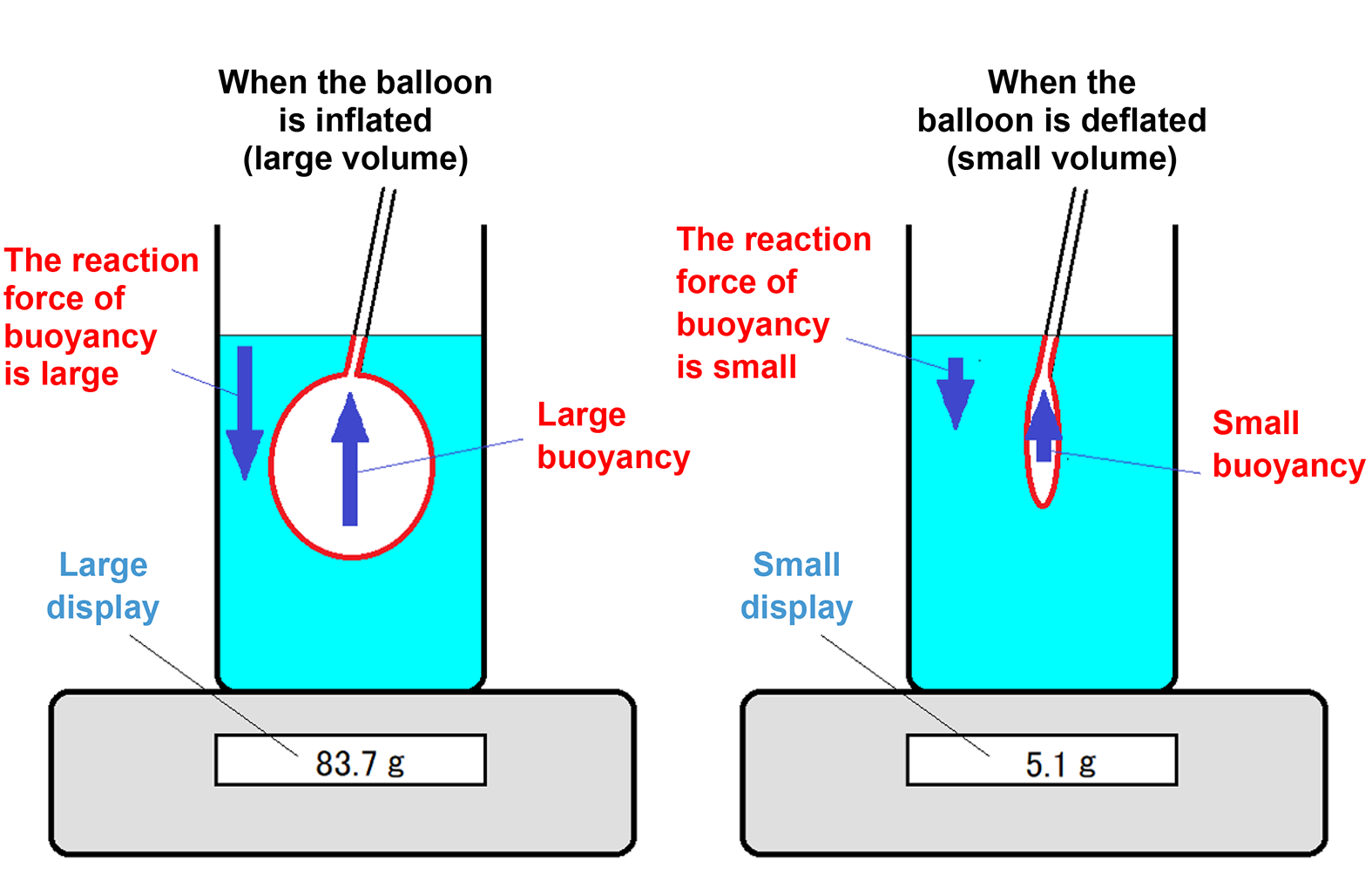
Experimental procedure and explanation:
- Use the principle of buoyancy to measure the volume of a balloon submerged in water.
- Place a container filled with water on the scale and reset the display to zero.
- Submerge a balloon (with a straw attached) fully underwater. Inflate or deflate the balloon while it is submerged. The scale reading will change accordingly.
- When submerging the balloon, ensure it does not touch the bottom or float above the surface, and that no air bubbles cling to it.
- When the balloon inflates, the displayed value (volume in water, cm3) increases; when deflated, it decreases. This reading represents the balloon’s volume (cm3), including the submerged portion of the straw.
- This video was produced with the support of the JSPS Grant-in-Aid for Scientific Research (18K03956).
| [Keywords] | Buoyancy |
| [Related items] | |
| [References] | Ryozo Ishiwata and Mitsumasa Nemoto, “The Wonder of Flow,” Kodansha Bluebacks, pp. 48–51. Ryozo Ishiwata, “Illustrated Fluid Dynamics Trivia,” Natsume Publishing, pp. 188–189. |
Last Update: 2021.6.1