

Floating Stainless Steel Ball
Let's take a look!
What type of experiment is this?
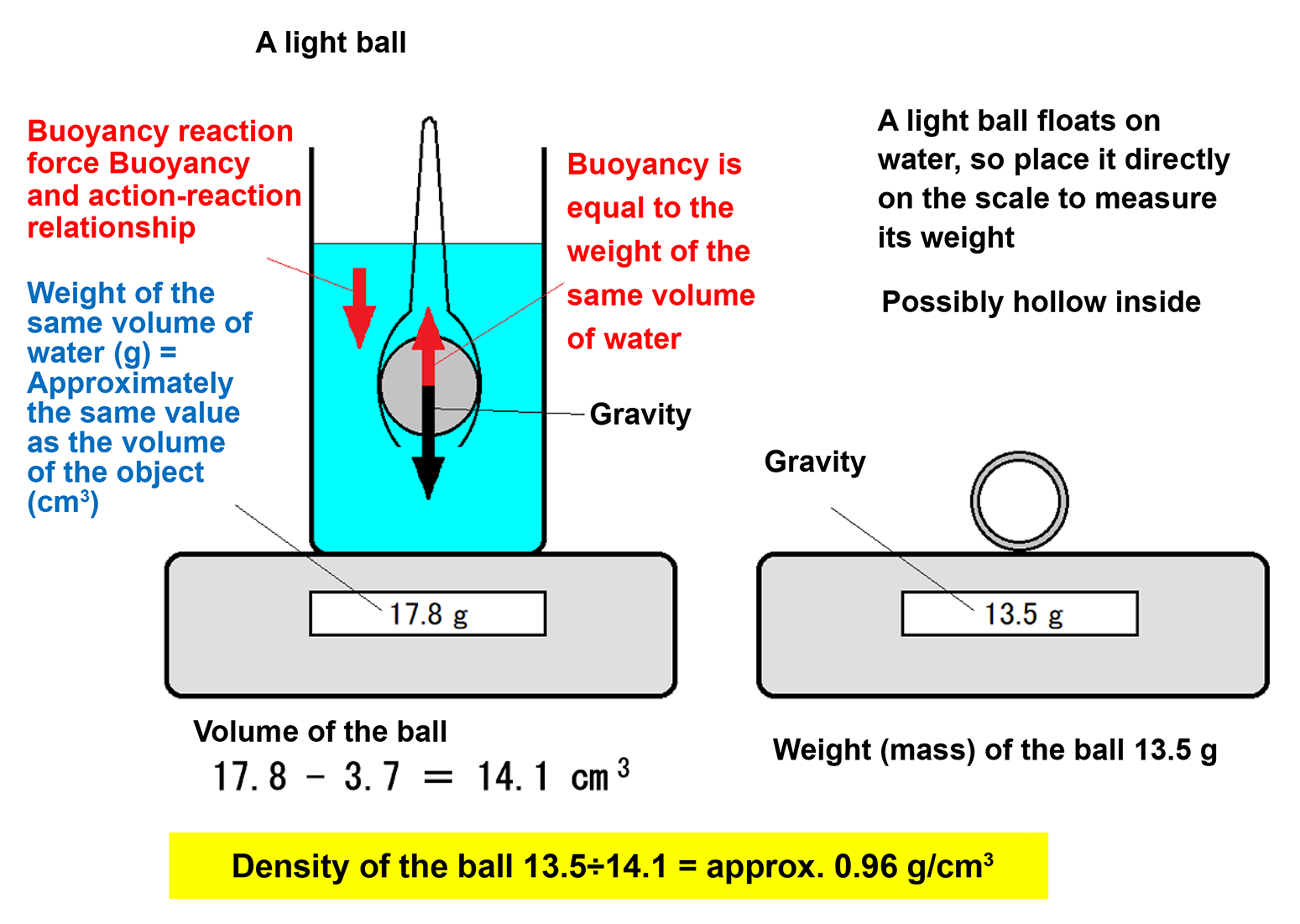
Experimental procedure and explanation:
- There are two stainless steel balls that look identical but differ in weight.
- Let’s measure the density of each medal using the method described in “Which is Heavier, Water or Stone?”
- Place a container filled with water on the scale and reset the display to zero (0 g).
- Submerge the stainless steel ball halfway to measure its volume, then fully immerse it to measure its weight (mass).
- The volume of the heavier stainless steel ball is 18.2 cm3 (including 3.7 cm3 from the tongs), and its weight (mass) is 111.7 g. Calculate the density as follows: (Density) = (mass) ÷ (volume) = 111.7 (g) ÷ (18.2 − 3.7) (cm3) = approximately 7.7 (g/cm3). This value corresponds to the density of ordinary stainless steel.
- The volume of the lighter stainless steel ball is 17.8 cm3 (including 3.7 cm3 from the tongs), and its weight (mass) is 13.5 g. Calculate the density as (Density) = (mass) ÷ (volume) = 13.5 (g) ÷ (17.8 − 3.7) (cm3) = approximately 0.96 (g/cm3).
This value represents the average density (total mass divided by total volume). This average density is less than that of water (1.0 g/cm3), explaining why the ball floats. - The light stainless steel ball is likely hollow. Assuming uniform wall thickness and that the material is stainless steel, the walls are estimated to be very thin—around 0.6 to 0.7 mm. By measuring an object’s mass and volume, we can estimate such structural details.
- This video was produced with the support of the JSPS Grant-in-Aid for Scientific Research (18K03956).
| [Keywords] | Buoyancy |
| [Related items] | |
| [References] | Ryozo Ishiwata and Mitsumasa Nemoto, “The Wonder of Flow,” Kodansha Bluebacks, pp. 48–51. Ryozo Ishiwata, “Illustrated Fluid Dynamics Trivia,” Natsume Publishing, pp. 188–189. |
Last Update: 2021.8.1